The best low-speed electric scooter for students in the Tricity
If you are a student in Chandigarh, Mohali, or Panchkula looking for a scooter to cover the daily college run — and you are 16 or older, do not yet hold a…
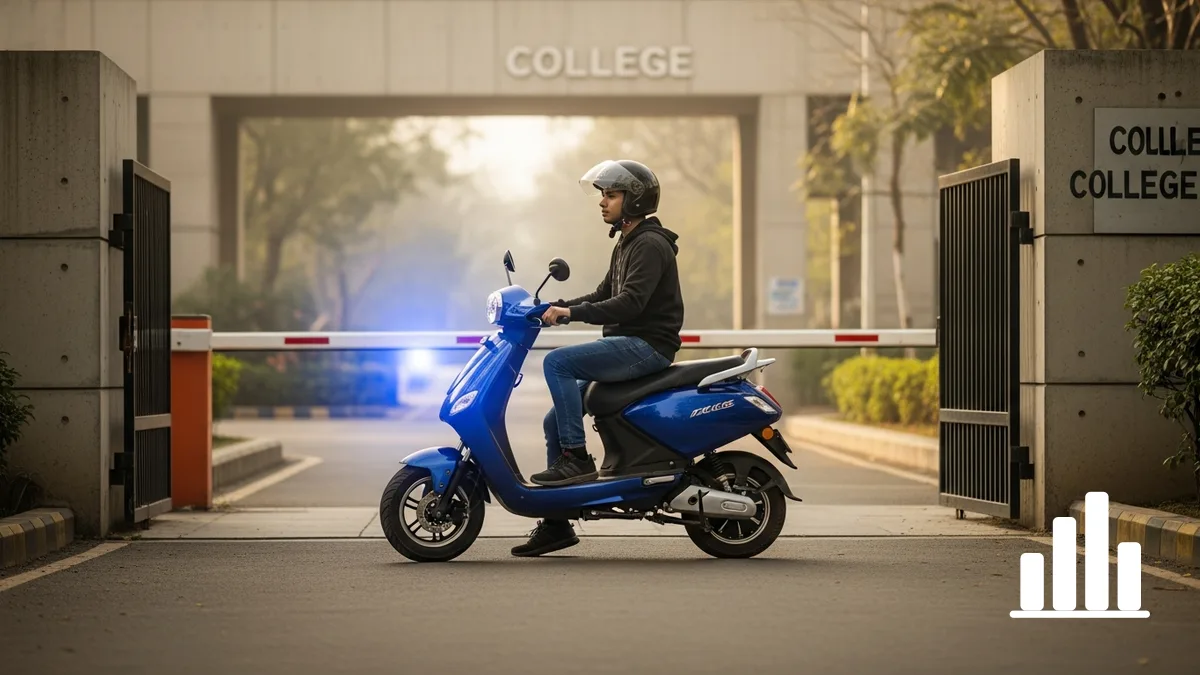
Who this guide is for
If you are a student in Chandigarh, Mohali, or Panchkula looking for a scooter to cover the daily college run — and you are 16 or older, do not yet hold a licence, and want to keep running costs low — a low-speed electric scooter is worth a serious look. This guide explains the rules, the numbers, and how to match a model to your actual daily distance. It does not push any single product; the right choice depends on your route, your budget, and the battery variant you select.
The rule that makes this category interesting for students
Under the Central Motor Vehicles Rules (CMVR), a two-wheeler that meets both of the following conditions is exempt from RTO registration, road tax, and a driving licence:
- Top speed of 25 km/h or less, and
- Motor rated at 250 W or less (continuous)
Both conditions must be satisfied simultaneously. Speed alone is not enough — a scooter electronically capped at 25 km/h but fitted with a motor rated above 250 W is still classified as a registrable motor vehicle and requires a licence and registration. This is the point most buyers overlook, so check the motor wattage on the specification sheet before you buy, not after.
The practical consequence for a 16-year-old student in the Tricity:
- No learner’s licence, no permanent licence needed
- No visit to the RTO, no registration number, no road tax
- No mandatory insurance (though voluntary third-party cover is available and sensible — confirm the current on-ground position with your local RTO, as interpretations vary)
- The scooter is ready to ride the day you bring it home
- Total on-road cost equals the ex-showroom price — no add-ons
The Central Motor Vehicles Rules apply identically across Chandigarh (Union Territory), Mohali (Punjab), and Panchkula (Haryana). Day-to-day enforcement can differ slightly between the three jurisdictions, so if you have a specific query about your area, confirm it with your local RTO.
What a college commute actually costs to run
Most college distances within the Tricity — say, a Sector 17 hostel to Panjab University, or a Mohali flat to a Sector 26 college — fall within 8 to 20 km each way. A low-speed electric scooter handles this comfortably.
Running cost worked example:
A full charge on a low-speed scooter draws roughly 2 units (kWh) of electricity. At approximately Rs 5 per unit — a fair all-in basis that accounts for the fixed charge and electricity duty on top of the energy charge — a full charge costs around Rs 10.
Over a rated range of around 60 km, that works out to roughly Rs 0.17 per km.
For context: the same 60 km on a petrol two-wheeler would cost Rs 150–200 in fuel (per charging-cost data from manufacturer and EV India guidance, cross-checked against the JERC tariff).
A note on the Chandigarh tariff specifically: per the JERC five-year tariff order (effective 1 November 2025, issued after the transition to Chandigarh Power Distribution Ltd), the domestic rate is tiered — roughly Rs 2.75 per unit at the lowest slab, around Rs 4.80 per unit for 151–400 units, and about Rs 5.40 per unit above 400 units. If your household stays in the lower consumption band, your actual per-charge cost will be somewhat less than Rs 10. Mohali (PSPCL, Punjab) sits at around Rs 5.40 per unit for the first 300 units; Panchkula (UHBVN, Haryana) is comparable. The Rs 5/unit basis used here is a reasonable middle estimate — not the cheapest possible, not the dearest.
What low-speed scooters do not offer
Before shortlisting models, be clear about the trade-offs:
- Top speed is 25 km/h. On Chandigarh’s sector roads and campus lanes this is workable, but it is not suited to arterial roads or highway stretches where traffic moves at 50–60 km/h. If your route involves a significant stretch of fast-moving traffic, reconsider.
- No government subsidy applies to this category. The current central scheme — PM E-DRIVE — applies only to registered, licensed high-speed electric two-wheelers with a lithium-ion battery, priced ex-factory up to Rs 1.5 lakh. Low-speed, CMVR-exempt scooters are not registered vehicles and do not qualify. The value here is in costs you avoid, not subsidies you receive.
- Lead-acid variants are heavier and slower to charge (roughly 7–12 hours) versus lithium-ion variants (roughly 4–5 hours). For daily use above 60 km, a lithium-ion battery is worth the higher upfront cost.
Matching range to your actual route
This is where most students go wrong. The rated range on the sticker assumes flat roads, a moderate load, and a specific battery configuration. Real-world range is lower in stop-start city traffic, in summer heat, and with a loaded carrier rack.
A rough guide for Tricity students:
| Daily round-trip distance | What to look for |
|---|---|
| Up to 20 km | Entry lead-acid models; rated range of 60 km gives comfortable headroom |
| 20–40 km | Mid-range model with 80–90 km rated range, or entry lithium-ion variant |
| 40–60 km | Choose a model rated at 100–120 km, ideally on lithium-ion |
| Above 60 km | Consider whether a low-speed scooter is the right tool; if yes, pick the highest-range variant available and plan a midday top-up |
Charging on a regular home socket (5-amp, 230 V) works fine overnight. Hostel residents should check whether their room socket is rated for overnight charging and whether the hostel management permits it — this is a practical question, not a technical one.
The model landscape: shop by class, not by brand
For a student commute you almost always want the entry-commuter class: roughly a 60–70 km real range and a ₹35,000–45,000 typical price band, in a compact step-through that is light, easy to park and cheap to run. That spec — not any single brand — is what to shortlist against. Several brands build to it; the table below names a few as examples, in alphabetical order. They are illustrations of the class, not a ranking or a recommendation.
| Class | Typical price band | Real range | Representative models (examples) |
|---|---|---|---|
| Entry commuter | ₹35,000–45,000 | 60–70 km | Komaki X-One · Kinetic Green Zing · Zelio Little Gracy |
| Everyday step-through | ₹45,000–60,000 | 70–85 km | Hero Electric Flash LX · Deltic Costa · Zelio Gracy i |
Prices are indicative bands, not exact ex-showroom figures — they vary by battery variant (lead-acid vs lithium), by state and over time, and not every model is stocked at every dealer. Confirm the current price, the real loaded range, and that the motor is rated ≤250W (so it stays licence-free) at your nearest authorised dealer before deciding.
For a 10–15 km daily commute with overnight charging, an entry-commuter scooter is usually plenty. Step up to the everyday class only if your daily distance pushes past 60 km or you want fuller moped ergonomics — and in either case, choose lithium over lead-acid if your daily distance is on the higher side, for the lighter weight and longer battery life.
A buyer’s checklist for Tricity students
Before you finalise any model, go through these points:
- Confirm motor wattage is 250 W or less — this is the condition that gives you the no-licence exemption, and it should appear on the specification sheet or the product brochure
- Confirm top speed is 25 km/h or less — same requirement
- Calculate your actual daily distance both ways, then add a 20–25 per cent buffer before choosing a range tier
- Decide on battery type: if you charge overnight at home or in a hostel room and your commute is under 50 km, a lead-acid variant at a lower price may suffice; for longer distances or faster charging, lithium-ion is worth the premium
- Ask the dealer for the current ex-showroom price in your city — Chandigarh, Mohali, and Panchkula prices can vary slightly given different state frameworks
- Ask about the service centre nearest to your college or home — a well-established brand will have an authorised service network, but confirm there is one conveniently located for you
- For insurance: while not legally mandated for CMVR-exempt low-speed scooters, voluntary third-party cover is available and worth considering given the cost of any accident or theft; confirm the current requirement with your local RTO
The honest bottom line
A low-speed electric scooter is a sensible fit for a Tricity student whose daily commute is within 20–40 km, who does not yet hold a licence, and who wants the lowest possible running cost. At roughly Rs 0.17 per km (per the JERC tariff basis and manufacturer range data), the fuel saving over a petrol scooter is substantial across a semester.
The trade-off is a 25 km/h ceiling, which limits it to calmer roads and campus routes. It is not a replacement for a high-speed scooter on arterial roads.
The correct approach is to measure your actual daily route, check both the speed and the motor wattage on any model you consider, and verify the current price with a dealer. The numbers in this guide are a starting framework — they are not a substitute for a direct conversation with an authorised dealer in your part of the Tricity.
Sources
- Central Motor Vehicles Rules (CMVR) — low-speed exemption criteria; cross-verified June 2026
- Joint Electricity Regulatory Commission (JERC) / Chandigarh Power Distribution Ltd — five-year tariff order, effective 1 November 2025; reported in The Tribune, October/November 2025
- PSPCL (Punjab) domestic tariff — approximately Rs 5.40 per unit for first 300 units
- UHBVN (Haryana) domestic tariff — comparable to PSPCL
- Manufacturer sites (including Komaki, Hero Electric, Deltic, Kinetic Green and Zelio) and trade listings — low-speed class specifications and indicative price/range bands, verified June 2026
- PM E-DRIVE scheme portal (pmedrive.heavyindustries.gov.in) and trade press — subsidy eligibility, June 2026
- EV India guidance and manufacturer data — per-km running cost basis, June 2026
Independent editorial — EV Chandigarh doesn't sell vehicles. We explain the rules and the numbers, then point you to where to buy.
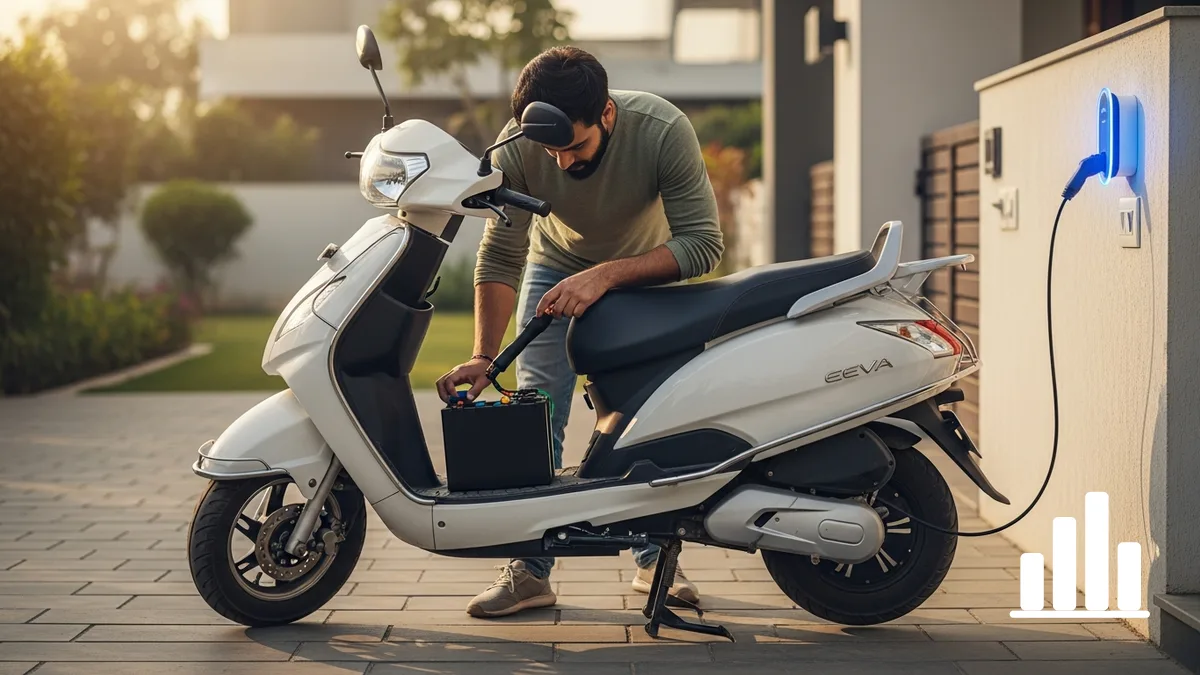
Buying a used low-speed electric scooter in the Tricity: the checks that matter
Buying a second-hand low-speed electric scooter in the Tricity is not the same as buying a used petrol two-wheeler, and it is not the same as buying a…
Read →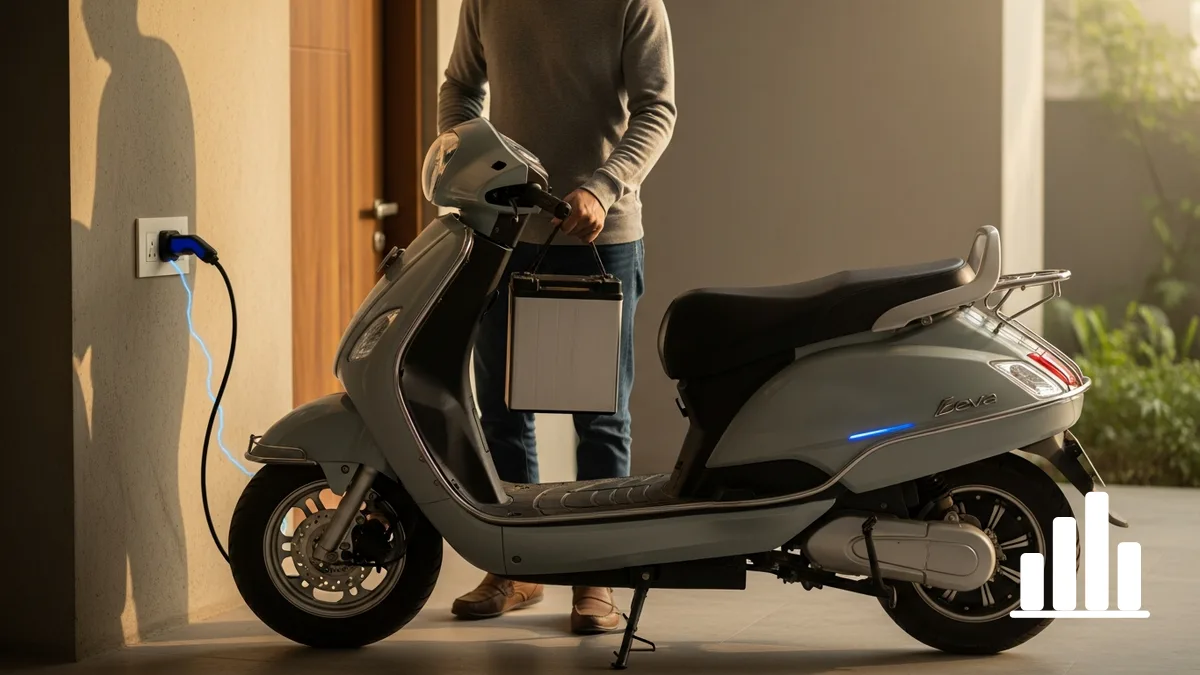
Charging a low-speed EV without a garage: options for Tricity flats
Living in a flat or rented accommodation in the Tricity — Chandigarh, Mohali, Panchkula — does not automatically lock you out of EV ownership. But it does…
Read →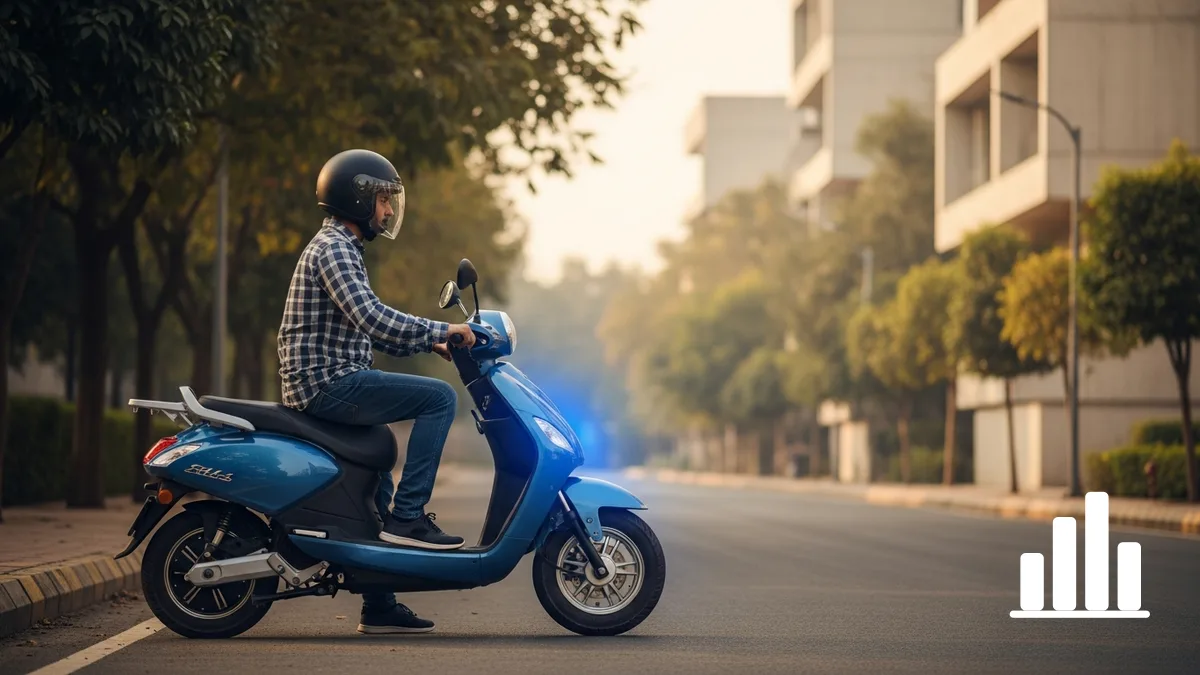
How to choose your first electric scooter — a simple Tricity guide
Thinking about your first electric scooter? Plenty of people in Chandigarh, Mohali and Panchkula doing 20–40 km a day — students, homemakers, delivery workers — ask the same questions. This guide answers them, without pushing any one brand.
Read →