Charging a low-speed EV without a garage: options for Tricity flats
Living in a flat or rented accommodation in the Tricity — Chandigarh, Mohali, Panchkula — does not automatically lock you out of EV ownership. But it does…
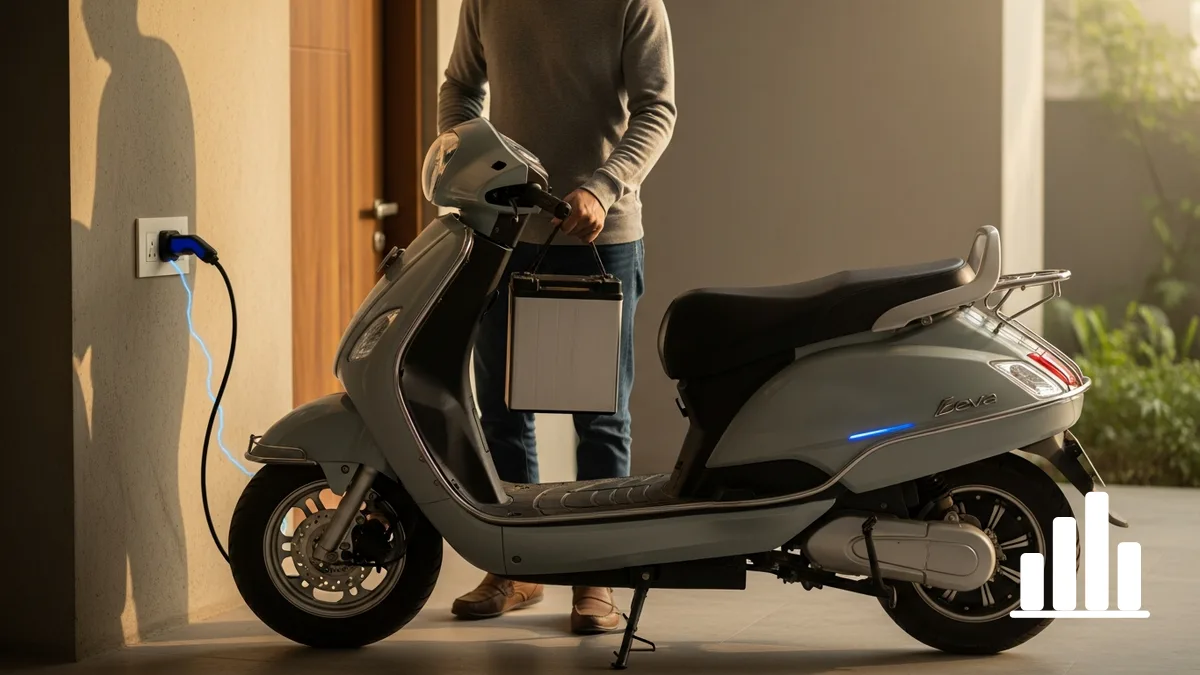
Living in a flat or rented accommodation in the Tricity — Chandigarh, Mohali, Panchkula — does not automatically lock you out of EV ownership. But it does raise a question that deserves a straight answer: if you have no garage and no dedicated charging point, where exactly do you plug in? This article works through the practical options, specific to low-speed electric scooters that draw around 2 units of electricity for a full charge.
Why the “where do I plug in” question is different for flats
A homeowner with a private garage has a single obvious answer: install a dedicated socket near the vehicle and charge overnight. A flat resident does not have that luxury. The charger port, the extension cable, the landlord, the society committee, and the building’s common-area electricity metering can all get in the way.
The good news is that low-speed scooters make this problem smaller than it sounds. A full charge consumes around 2 units of electricity, per verified charging data for this class of vehicle. At the all-in domestic rate of around Rs 5 per unit — a realistic average across Chandigarh, Mohali, and Panchkula — a full charge costs roughly Rs 10. The small energy draw means a standard household socket is sufficient. You do not need a fast charger or any special installation.
Option 1: Removable battery — the cleanest solution for flat residents
Several scooters in the long-range and work class carry batteries that detach from the vehicle. Models in this segment — such as the Deltic Legion, the Komaki XGT VP, and the Zelio Logix, which sit in a price band of around Rs 60,000 to Rs 95,000 — are designed with removable battery packs. Before relying on any specific model for this feature, confirm it on the dealer’s specification sheet; variants within a model line sometimes differ.
With a removable battery, the process is straightforward: detach the pack at the vehicle, carry it upstairs, and plug the charger into any standard 5-amp socket in your flat. The vehicle stays in the parking area or on the street. No cable running down a stairwell, no negotiating with the society, no extension cord across a corridor.
This option suits residents in the older sectors of Chandigarh, in Mohali’s apartment complexes, and in Panchkula’s housing societies, where ground-floor parking is common but electrical access to that parking is not.
Practical points to confirm before buying a removable-battery model:
- Ask the dealer to demonstrate the removal process. Battery packs vary in weight; some are light enough to carry one-handed, others are not.
- Confirm the battery charger specs: most low-speed scooter chargers run on a standard 5-amp socket. Some higher-capacity packs may need a 15-amp socket — check this before assuming your kitchen or bedroom socket is sufficient.
- Confirm that the battery locking mechanism is secure, so the pack cannot be removed without your key when the vehicle is parked outside.
Option 2: A standard 5-amp or 15-amp socket — if you can get cable access
Where the battery is not removable — or where the rider prefers to charge the vehicle in place — the charger cable needs to reach a socket. Low-speed scooters draw modest power, and a standard domestic socket handles the load without any electrical modification.
The question is not electrical — it is physical and social. Can you run a cable from your flat to where the vehicle is parked, safely and with your landlord’s and society’s agreement?
In practice, this works in several situations that are common in the Tricity:
- Ground-floor or stilt-parking flats: A cable from an internal socket to a ground-floor parking bay is often feasible, particularly in older builder-floor construction common in Chandigarh’s sectors and in parts of Mohali and Panchkula.
- Society with a common charging facility: Some residential societies in Mohali’s IT City corridor and newer sectors of Panchkula have installed common charging points in their basement or stilt parking. If your society has one, confirm whether the electricity cost is included in maintenance charges or billed separately — this varies by society.
- Rented accommodation with landlord access to a meter point near parking: In many builder-floor rentals, the landlord’s meter is accessible near the parking area. With the landlord’s agreement, running a short cable for overnight charging is entirely practical. The roughly Rs 10 per full charge makes it easy to settle informally or have it folded into a fixed monthly amount.
What you should not do: Run an extension cable across a public footpath, stairwell, or common corridor without permission. Beyond the social friction, it creates a trip hazard and may violate your society’s rules.
Option 3: Workplace charging
If your employer provides parking and has electrical access nearby, workplace charging during office hours is a practical supplement, particularly for longer-range models that cover the round trip comfortably. Around 2 units for a full charge means the electricity cost to an employer is negligible — roughly Rs 10 per charge at standard domestic-adjacent commercial rates. Many employers who already allow this informally have never calculated the actual cost.
This is not a primary solution, but it is a useful backup for riders whose home situation is difficult.
Option 4: Public charging points in the Tricity
Public charging infrastructure for two-wheelers in Chandigarh, Mohali, and Panchkula is growing but remains patchy for the low-speed class. Before relying on this option, it is worth confirming on the ground: the network, pricing, and connector compatibility for low-speed scooters at specific locations should be verified locally, as the situation changes. This article cannot state verified figures on public charging availability without risking outdated information.
Public charging works best as a fallback, not a daily plan, for most flat residents at present.
The electricity arithmetic for flat residents
Understanding the numbers helps when negotiating with a landlord or society.
A full charge consumes around 2 units of electricity, per the verified charging data for this class. In Chandigarh, the JERC domestic tariff — effective from 1 November 2025, under the JERC five-year tariff order — runs from around Rs 2.75 per unit at the lowest slab to around Rs 5.40 per unit above 400 units per month, with a fixed charge of approximately Rs 20 to 30 per kW per month and a small electricity duty. In Mohali, PSPCL charges around Rs 5.40 per unit for the first 300 units. Panchkula, under UHBVN, is broadly comparable.
Using approximately Rs 5 per unit as an honest all-in working figure:
- Full charge: around 2 units, costing roughly Rs 10
- Per kilometre running cost: around Rs 0.17, over a typical range of around 60 km for an entry-class scooter
- Monthly electricity addition to your flat bill (daily charging): roughly Rs 300 per month
That Rs 300 monthly addition is easy to account for with a landlord, and small enough that many landlords in the Tricity’s builder-floor rental market are comfortable absorbing it or adding it as a flat fee.
What class of scooter suits which charging situation
The models.json data (the class reference this site maintains) covers three low-speed classes. From a charging-access standpoint:
- Entry commuter (around Rs 35,000 to 45,000, 60 to 70 km range): Lead-acid or entry lithium. These batteries are generally not removable. Flat residents in this segment depend on cable access to a nearby socket, or a society charging point.
- Everyday step-through (around Rs 45,000 to 60,000, 70 to 85 km range): Lithium, full moped ergonomics. Battery removability varies by model — confirm with the dealer on the specific SKU. Representative models in this class include the Hero Electric Flash LX, Deltic Costa, and Zelio Gracy i.
- Long-range and work (around Rs 60,000 to 95,000, 90 to 110 km range): Often removable lithium or LFP packs. This class — including models such as the Deltic Legion, Komaki XGT VP, and Zelio Logix — is the most flat-friendly for charging, assuming the specific variant has a removable pack. Confirm the specification before purchase.
Before purchasing any of these models as licence-free, verify that the specific variant has a continuous motor rating of 250W or less AND a top speed of 25 km/h or less. Under the Central Motor Vehicles Rules, both conditions must be satisfied together for the CMVR exemption to apply — speed alone is not enough. For the Komaki XGT VP specifically, the models data notes that it should be confirmed locally before relying on it, as some XGT trims appear in registered, high-speed form.
A note for renters specifically
Rented accommodation in the Tricity — particularly in Chandigarh’s sectors 20 to 40 corridor, in Mohali Phases 7 and 11, and in Panchkula’s Sectors 7 to 20 — is predominantly builder-floor or independent-house based. That construction type is more accommodating of informal charging arrangements than high-rise apartment blocks. A candid conversation with the landlord, explaining that the electricity cost is around Rs 10 per charge and roughly Rs 300 per month, often resolves the question immediately.
For high-rise residents with basement parking and no cable access, the removable-battery option is the most practical solution available without any building modification or society approval.
Summary: matching your living situation to a charging approach
| Situation | Most practical option |
|---|---|
| Basement or stilt parking, no cable access | Removable battery scooter; carry pack to flat |
| Builder-floor with nearby socket | 5-amp socket via cable; landlord agreement |
| Society with common charging point | Use society facility; confirm billing |
| Office with parking and socket access | Workplace charging as supplement |
| High-rise, no removable battery, no society charger | Difficult at present; confirm locally before buying |
Sources
- Central Motor Vehicles Rules (CMVR) — low-speed exemption criteria (speed and motor power, both conditions required); cross-verified June 2026
- Joint Electricity Regulatory Commission (JERC) / Chandigarh Power Distribution Ltd — JERC five-year tariff order FY 2025-26 to 2029-30, effective 1 November 2025; reported in The Tribune, October/November 2025
- PSPCL domestic tariff for Mohali (Punjab) — approximately Rs 5.40 per unit for first 300 units
- UHBVN domestic tariff for Panchkula (Haryana) — noted as broadly comparable
- Charging consumption and cost data — approximately 2 units per full charge, approximately Rs 10 per charge at approximately Rs 5 per unit all-in; sourced from EV India guidance and JERC tariff, June 2026
- Model class reference — evchandigarh.in internal class data (brand-neutral; model names illustrative, not verified per-SKU claims)
Independent editorial — EV Chandigarh doesn't sell vehicles. We explain the rules and the numbers, then point you to where to buy.
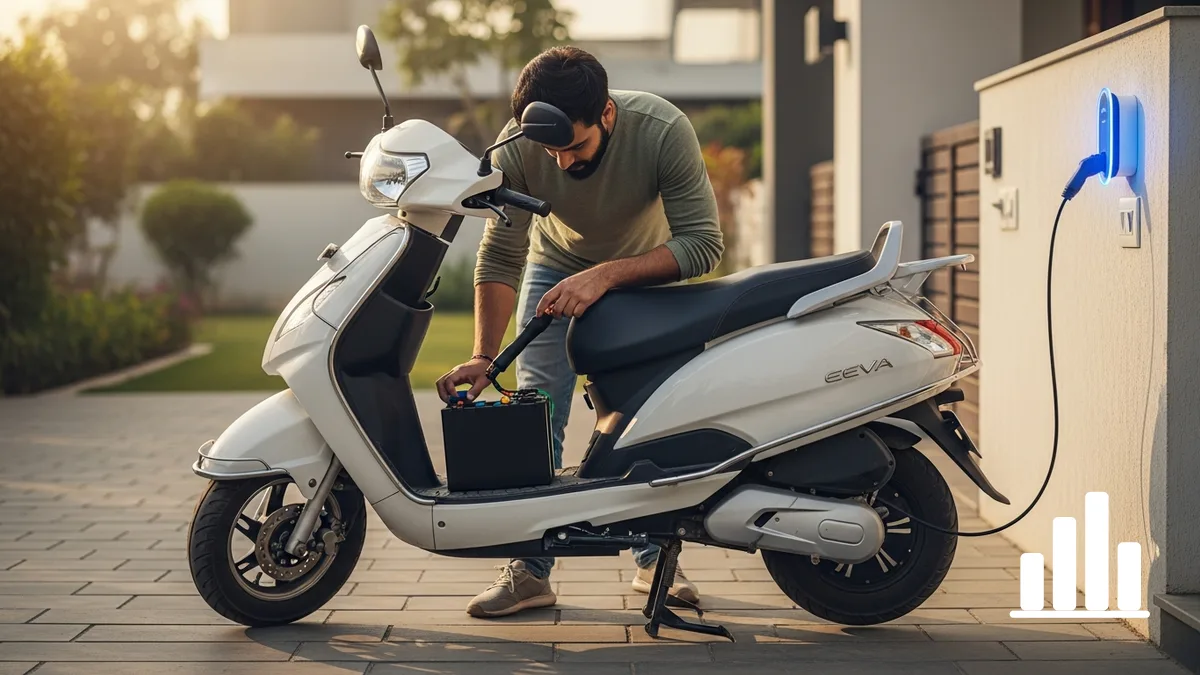
Buying a used low-speed electric scooter in the Tricity: the checks that matter
Buying a second-hand low-speed electric scooter in the Tricity is not the same as buying a used petrol two-wheeler, and it is not the same as buying a…
Read →
How to choose your first electric scooter — a simple Tricity guide
Thinking about your first electric scooter? Plenty of people in Chandigarh, Mohali and Panchkula doing 20–40 km a day — students, homemakers, delivery workers — ask the same questions. This guide answers them, without pushing any one brand.
Read →
Battery replacement cost and life: what a low-speed EV battery really costs to renew
When you budget for a low-speed electric scooter, the ex-showroom price is only part of the story. The battery is the single most expensive component, and…
Read →