Charging an electric scooter at home in the Tricity: what it really costs
A full overnight charge is roughly ₹10 — about two units at an all-in rate of around ₹5 per unit. Here's the math, the tiered tariff, and how the Tricity compares.
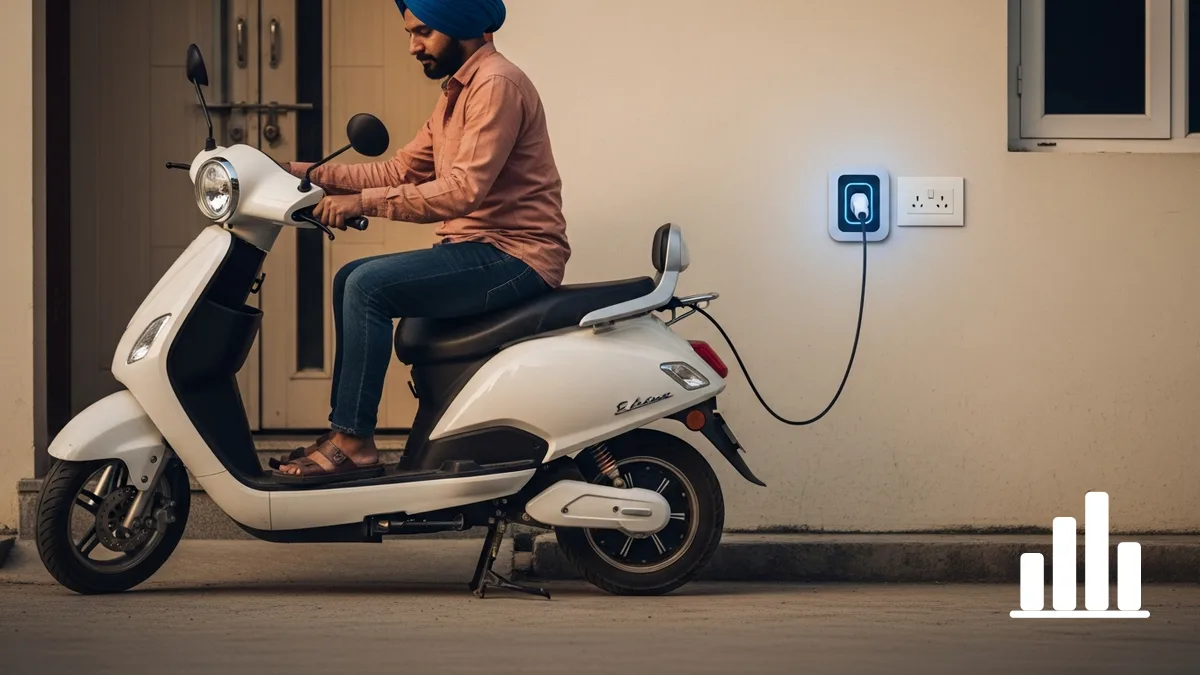
You don’t need a special charger or a special connection. A low-speed electric scooter charges from an ordinary 5A wall socket — the same one your phone uses — and the cost is small enough that most owners stop thinking about it. Here’s exactly what “small” means.
A full charge: about two units
A typical low-speed scooter draws roughly two units (kWh) for a full charge from empty. What those units cost depends on your domestic tariff slab.
In Chandigarh, the JERC domestic tariff (effective 1 November 2025) is tiered:
- around ₹2.75 per unit at the lowest slab
- around ₹4.80 per unit for 151–400 units
- around ₹5.40 per unit above 400 units
On top of the per-unit energy charge there’s a small fixed charge (roughly ₹20–30 per kW per month) and an electricity duty. So rather than quote the cheapest slab, it’s honest to work the running-cost maths on an all-in rate of about ₹5 per unit — a fair, slightly conservative average. Low-usage homes sitting on the lowest slab genuinely pay less.
At that all-in rate, a ~2-unit charge costs roughly ₹10 (less if you’re on the lowest slab).
Per kilometre, and against petrol
That works out to about ₹0.17 per km to run a low-speed EV — a ~₹10 charge spread over a roughly 60 km range. The same distance on a petrol scooter costs in the region of ₹2.5–3.3 per km.
Put concretely: a full overnight charge of roughly ₹10 moves you about as far as ₹150–200 of petrol would. That gap is the whole running-cost case for an EV, and it compounds every single day.
How the Tricity compares
Here’s a detail you won’t find on a national spec sheet. Chandigarh’s domestic tariff is tiered, so a modest-use household on the lowest slab (~₹2.75/unit) pays noticeably less than a heavy user climbing toward ₹5.40/unit.
Across the border, Mohali (PSPCL, Punjab) sits around ₹5.40/unit for the first 300 units, and Panchkula (Haryana) is broadly comparable. So the three cities are not far apart on a typical bill — the real, ownable point is that Chandigarh’s lower slabs reward light domestic use, not that it’s dramatically cheaper than its neighbours. Either way, at roughly ₹5 per unit all-in the running cost stays a fraction of petrol.
A worked example
Ride 30 km a day, every day:
- EV: ~₹5/day (30 km × ₹0.17) → about ₹150 a month
- Petrol: ~₹60–90/day → ₹1,800–2,700 a month
Even at the conservative end, that’s well over a thousand rupees a month back in your pocket — before you count oil changes, servicing and the price of the fuel itself rising.
The bottom line
Home charging a low-speed EV is cheap, simple and needs no infrastructure: a normal socket, about two units a night, roughly ₹10 a full charge at an all-in ₹5/unit. Across Chandigarh, Mohali and Panchkula alike, the running cost is low enough that the petrol comparison stops being close.
Sources
- Joint Electricity Regulatory Commission (JERC) / Chandigarh Power Distribution Ltd domestic tariff order, effective 1 November 2025 (tiered: ~₹2.75/unit lowest slab, ~₹4.80 for 151–400 units, ~₹5.40 above 400); reported in The Tribune, Oct/Nov 2025.
- Mohali / Punjab domestic tariff (PSPCL), ~₹5.40/unit for the first 300 units; Panchkula / Haryana comparable.
- Zelio official guidance and EV India running-cost figures; June 2026.
Independent editorial — EV Chandigarh doesn't sell vehicles. We explain the rules and the numbers, then point you to where to buy.
Buying a used low-speed electric scooter in the Tricity: the checks that matter
Buying a second-hand low-speed electric scooter in the Tricity is not the same as buying a used petrol two-wheeler, and it is not the same as buying a…
Read →
Charging a low-speed EV without a garage: options for Tricity flats
Living in a flat or rented accommodation in the Tricity — Chandigarh, Mohali, Panchkula — does not automatically lock you out of EV ownership. But it does…
Read →
How to choose your first electric scooter — a simple Tricity guide
Thinking about your first electric scooter? Plenty of people in Chandigarh, Mohali and Panchkula doing 20–40 km a day — students, homemakers, delivery workers — ask the same questions. This guide answers them, without pushing any one brand.
Read →