Do you actually need a licence for an electric scooter in Chandigarh?
The ≤25 km/h, ≤250W exemption lets you skip the RTO entirely — but there's a motor-power catch that quietly cancels it. Here's the rule, exactly.
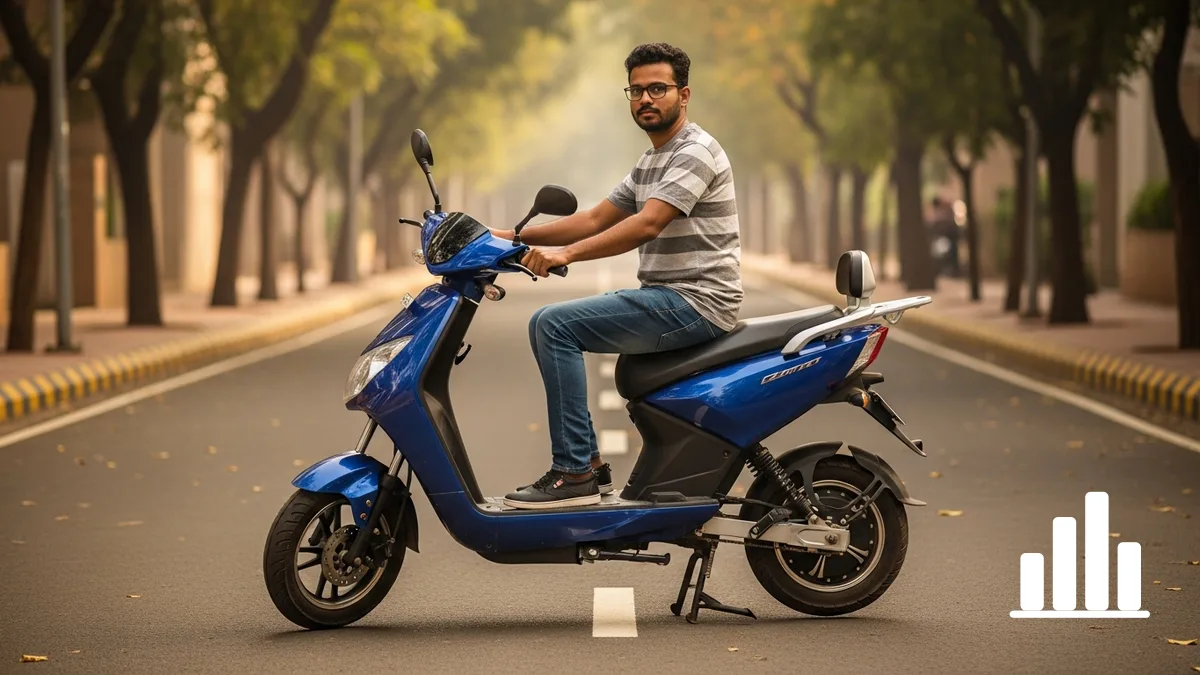
A low-speed electric scooter is the rare vehicle you can buy in the morning and ride home the same afternoon — no licence, no registration, no number plate. But that exemption rests on two numbers, and getting one of them wrong quietly turns a “no-paperwork” scooter into a vehicle the RTO expects to see.
The rule, exactly
Under the Central Motor Vehicles Rules (CMVR), an electric two-wheeler is exempt from registration and licensing only when it meets both of these conditions:
- a top speed of 25 km/h or less, and
- a continuous-rated motor of 250 watts or less.
Meet both and the scooter is not classified as a “motor vehicle” for registration. In practice that means no driving licence, no RTO registration, no road tax, no number plate, and no legally mandated insurance. The minimum age to ride is 16.
Because there’s no registration step, an exempt scooter is ready to ride the moment you buy it — your total on-road cost is simply the ex-showroom price.
The catch most sellers won’t mention
Speed alone is not enough. A scooter electronically capped at 25 km/h but fitted with a motor rated above 250W is still, in law, a registrable motor vehicle — licence, registration, road tax and all. The exemption checks power and speed together.
This is the single most common point that gets glossed over on a showroom floor. Before you treat any scooter as “no-licence”, confirm the continuous motor rating in writing — not the peak figure — and that it is 250W or under. Among the low-speed models sold across the Tricity (the Zelio Gracy and Logix lines, for instance), the mainstream variants are built to the ≤25 km/h, ≤250W spec — but the only number that protects you is the one on your scooter’s spec sheet.
What you save by staying exempt
Skipping registration saves a modest one-time amount — the green number plate (around ₹400–500, fitted only on registered EVs) and the registration processing — plus the time and paperwork. The bigger saving is recurring: you avoid mandatory insurance, which runs roughly ₹1,500–3,000 a year. Note that road tax is ₹0 on an electric two-wheeler in the Tricity even when registered (Chandigarh and Punjab both give a 100% EV road-tax exemption in 2026), so “no road tax” is not a low-speed-only saving — don’t overstate the registration side.
A note on insurance: third-party cover is not legally mandated for a non-RTO low-speed scooter, and voluntary cover is available and worth considering. Interpretations vary, and on-ground enforcement differs, so treat insurance as a “confirm with your local RTO” question rather than a settled yes/no.
Tricity nuance: one rule, three administrations
The CMVR is central law and applies identically across the region — but it’s enforced by three different transport set-ups:
- Chandigarh — Union Territory
- Mohali — Punjab
- Panchkula — Haryana
Day-to-day enforcement can differ slightly between the UT, Punjab and Haryana, so if you’re buying near a border or plan to ride across one regularly, confirm the current position with your local RTO before you rely on it.
The bottom line
If — and only if — your scooter is genuinely ≤25 km/h and ≤250W continuous, you need no licence and no registration, and you can ride it home today. If either number is over the line, it’s a registrable vehicle and the full RTO process applies. Check both before you buy.
Sources
- Central Motor Vehicles Rules (CMVR); cross-verified across multiple 2026 sources, June 2026.
Independent editorial — EV Chandigarh doesn't sell vehicles. We explain the rules and the numbers, then point you to where to buy.
Buying a used low-speed electric scooter in the Tricity: the checks that matter
Buying a second-hand low-speed electric scooter in the Tricity is not the same as buying a used petrol two-wheeler, and it is not the same as buying a…
Read →
Charging a low-speed EV without a garage: options for Tricity flats
Living in a flat or rented accommodation in the Tricity — Chandigarh, Mohali, Panchkula — does not automatically lock you out of EV ownership. But it does…
Read →
How to choose your first electric scooter — a simple Tricity guide
Thinking about your first electric scooter? Plenty of people in Chandigarh, Mohali and Panchkula doing 20–40 km a day — students, homemakers, delivery workers — ask the same questions. This guide answers them, without pushing any one brand.
Read →