Buying a used low-speed electric scooter in the Tricity: the checks that matter
Buying a second-hand low-speed electric scooter in the Tricity is not the same as buying a used petrol two-wheeler, and it is not the same as buying a…
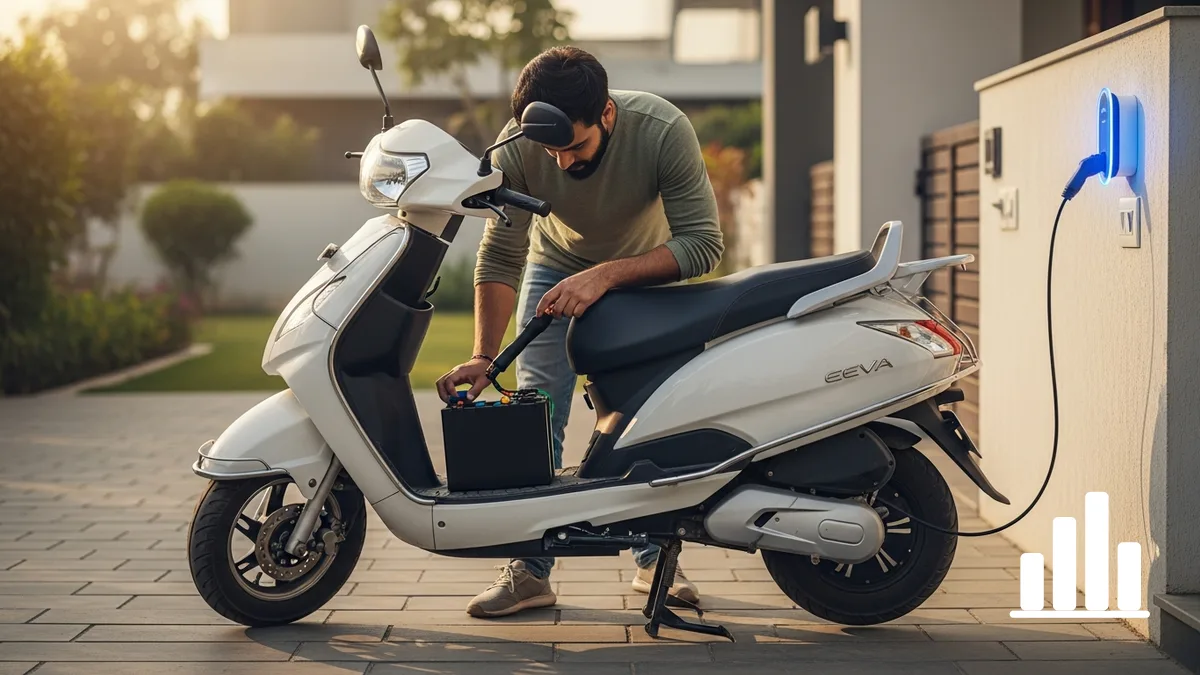
Buying a second-hand low-speed electric scooter in the Tricity is not the same as buying a used petrol two-wheeler, and it is not the same as buying a used high-speed EV either. The paperwork is lighter, the transfer process is simpler, and the running costs stay low — but the risks are concentrated in one place that most buyers overlook: the battery. This guide walks through every check that matters, in the order it matters.
What “low-speed exempt” means on a used unit
Before anything else, confirm you are actually dealing with a CMVR-exempt scooter. Under the Central Motor Vehicles Rules, a scooter qualifies for the exemption — no licence, no RTO registration, no road tax, no mandatory insurance — only when both of the following are true simultaneously:
- Top speed is 25 km/h or less
- The motor’s continuous rated power is 250W or less
Speed alone is not enough. A scooter electronically capped at 25 km/h but fitted with a motor rated above 250W continuous is still a registrable motor vehicle under the CMVR. This is the single most common misunderstanding in this category.
On a new purchase you check the spec sheet. On a used unit with incomplete paperwork, this is harder. Here is how to approach it practically:
Check the motor label. Most hub motors carry a small metal or adhesive plate on the motor casing. Look for “Rated Power” or “Continuous Power” in watts. If the label is missing or unreadable, ask the seller for a photo of the original invoice or the manufacturer’s product page for that exact model code — motor ratings sometimes vary between trim levels of the same model name.
Cross-check the controller. The controller (usually a black box near the battery) often carries a rating stamp. A 250W-class controller is a reasonable secondary indicator, though not conclusive.
Check if any RTO paperwork exists. If the scooter was legitimately purchased as a low-speed exempt unit, there will be no Registration Certificate, no number plate, and no Form 23 transfer. If you are handed an RC book for what the seller calls a “no-registration scooter”, something does not add up — either the motor exceeds 250W, or the scooter was registered for another reason.
When in doubt, confirm with your local RTO (Sector 17 office for Chandigarh, or the Mohali/Panchkula equivalent) whether the motor rating on that specific unit crosses the threshold.
The RTO transfer question — and why it does not apply here
This is the part that confuses most used-vehicle buyers in the Tricity.
When you buy a used car or a registered two-wheeler, you go to the RTO, pay the transfer fee, and get the RC transferred to your name. For a CMVR-exempt low-speed scooter, none of that process exists — because the scooter was never registered in the first place.
There is no RC to transfer. There is no Form 29 or Form 30. There is no hypothecation clearance to chase unless the original buyer financed the purchase and the lender holds documentation separately.
The practical result: ownership transfer on a legitimately exempt scooter is a private transaction. You take the original purchase invoice, a written sale receipt from the seller, and whatever warranty card or battery service records exist — and that is your paper trail. The moment you buy, you can ride.
This simplicity is real, but it has a consequence: there is no government record linking the scooter to any owner. If the unit was stolen, there is no VAHAN database entry to flag it. Ask the seller for the original dealer invoice with a matching chassis number or motor serial number, and physically verify those numbers on the scooter before paying.
Battery age and health: the real depreciating part
On a low-speed scooter, the battery is where most of the value lives — and where most of the depreciation happens. The frame, the motor, the controller, and the electronics are relatively durable. The battery is not.
Lead-acid batteries
Many entry-class low-speed scooters in the Tricity market — typically priced new in the Rs 35,000–45,000 band — use sealed lead-acid (SLA) batteries. These typically last 300–500 charge cycles in good conditions, which translates to roughly 18–30 months of regular daily use before capacity drops noticeably. A used lead-acid scooter that is two or more years old has likely already degraded significantly.
Signs of an aged or failing lead-acid pack:
- Charging time has shortened (paradoxically, old lead-acid charges fast because it cannot absorb much energy)
- Range has dropped from what the seller claims
- The battery becomes warm to the touch during a normal charge
- The scooter feels sluggish on inclines even on a full charge
Ask when the battery was last replaced, and ask for any dealer service record. If the seller does not know or the records do not exist, price the unit as if the battery needs replacement soon.
Replacement cost of a lead-acid set varies by pack size; confirm current prices with a service centre locally before budgeting, as component prices shift. Do not accept a seller’s verbal estimate as final.
Lithium batteries (NMC or LFP)
Mid-range and long-range class low-speed scooters — new price bands of Rs 45,000–95,000 — more commonly use lithium packs. These last considerably longer (often 800–1,000 cycles or more for LFP chemistry), degrade more gracefully, and are lighter. On a used lithium scooter:
- Ask for the battery manufacture date if it is printed on the pack or in the warranty card
- A lithium pack under three years old with reasonable use should still deliver 80% or more of its original capacity
- Look for any BMS fault indicators on the display — most lithium systems show a warning when a cell group is significantly out of balance
Some long-range class scooters in this category use removable battery packs. On a removable-pack unit, ask whether the original pack is included, and physically inspect the connectors for corrosion or heat marks.
The honest range test
Do not rely on the seller’s claimed range or the manufacturer’s rated figure. Rated range figures in brochures for low-speed scooters are measured under controlled, favourable conditions. Real-world range is typically around 78% of the rated figure, sometimes less on an ageing pack.
Conduct your own test:
- Charge the scooter fully and note when the charger’s indicator light changes (most chargers have a red-to-green or similar indicator)
- Ride a known route — the Sukhna Lake loop, a stretch along the IT Park road in Mohali, or any route where you know the distance from Maps — under normal load and speed
- Note the state-of-charge indicator (if fitted) or simply ride until the battery warning kicks in, then check the odometer
- Compare against the seller’s claimed range and the manufacturer’s rated figure
If a scooter is rated at 85 km and you get 45 km on a full charge, the battery is significantly degraded. A healthy battery should return at least 60–65 km on that same rated range.
Do this test before agreeing on a price, not after.
Verifying the spec without clear paperwork
Used low-speed scooters in the Tricity informal market often change hands with just the original purchase invoice — or sometimes without even that. If paperwork is missing or incomplete, here is a practical verification sequence:
-
Model code matters. Write down the exact model name and any alphanumeric trim code from the scooter’s body badge or sticker. Several brands — including those making scooters in the entry and mid-range classes — sell the same model name in both a low-speed (exempt) trim and a higher-power (registered) trim. The trim code distinguishes them. Confirm the spec on the manufacturer’s website or by calling their customer care with the chassis number.
-
Chassis and motor serial number. These are usually stamped on the frame near the footboard and on the motor housing respectively. If the seller can provide the original invoice, the chassis number should match. A mismatch is a serious red flag.
-
The controller rating. As noted above, the controller’s rated input/output gives a cross-reference. A controller labelled for 250W or 350W peak with a low continuous rating is consistent with an exempt-class motor. A controller labelled 500W or above points to a higher-power motor.
-
Physical speed test. Ride the scooter on a flat, straight road with no headwind. A properly functioning CMVR-exempt scooter will not exceed 25 km/h regardless of how far you twist the throttle. Use a GPS-based speed app on your phone for an independent reading — the onboard speedometer may not be accurate. If the unit is easily touching 35 or 40 km/h, it is not a low-speed-exempt scooter.
Running costs after you buy
The operating cost advantage of a low-speed EV does not change much between new and used — it depends on the battery capacity and the electricity tariff, both of which remain the same.
Per the JERC tariff order effective 1 November 2025, Chandigarh’s domestic tariff runs from around Rs 2.75 per unit at the lowest slab to around Rs 5.40 per unit above 400 units. Mohali (PSPCL, Punjab) sits around Rs 5.40 per unit for the first 300 units. Panchkula (Haryana, UHBVN) is comparable. Using around Rs 5 per unit as a realistic all-in average across slabs and fixed charges, a full charge on a typical low-speed scooter uses around 2 units and costs around Rs 10. That works out to around Rs 0.17 per km over a real-world range of around 60 km — against Rs 150–200 of petrol for the same distance.
The arithmetic on a used unit is the same, provided the battery is still healthy enough to take a full charge.
What you are actually saving — and what you are not
The value of a CMVR-exempt low-speed scooter is in avoided costs, not in subsidies. Subsidies under PM E-DRIVE apply only to registered, high-speed electric two-wheelers with lithium batteries and ex-factory prices up to Rs 1.5 lakh — not to low-speed exempt scooters, which are unregistered and often lead-acid. Do not let any seller tell you otherwise.
What you genuinely avoid with an exempt scooter:
- RTO registration and processing (a one-time saving, though modest — mainly the green number plate at around Rs 400–500 and administrative fees; registered EVs already pay zero road tax in Chandigarh and Punjab in 2026, so “saving on road tax” is not the right framing here)
- Mandatory third-party insurance: an annual saving of roughly Rs 1,500–3,000 per year. The legal position on whether an exempt scooter still needs third-party cover under the Motor Vehicles Act is debated, and on-ground enforcement varies across Chandigarh, Mohali, and Panchkula. Voluntary cover is available and worth considering. Confirm the current position with your local RTO rather than relying on a blanket answer
- The need for a driving licence (minimum age for riding is 16 years under the CMVR)
On a used purchase, you also avoid the RTO transfer process entirely — because there is nothing to transfer.
Pricing a used unit: a working framework
Because this is a private transaction with no VAHAN record, there is no standardised valuation. A few reference points:
- Entry-class scooters (lead-acid, rated 60–70 km) sell new in the Rs 35,000–45,000 band. A two-year-old unit with a degraded lead-acid battery may need a battery replacement factored into your offer price.
- Mid-range class (lithium, rated 70–85 km) sells new in the Rs 45,000–60,000 band. A two-to-three-year-old unit with a healthy lithium pack should still deliver reasonable range.
- Long-range class (lithium/LFP, rated 90–110 km) sells new in the Rs 60,000–95,000 band. Used pricing here is harder to anchor without knowing the battery history.
The honest position: the battery health test described above should drive your negotiating position more than any listed price. A scooter with a degraded battery at a “good” price is not necessarily a good deal.
A summary checklist before you pay
- Confirm both the speed cap (25 km/h or less) and the motor rating (250W or less continuous) — verify both, not just one
- Get the original purchase invoice; match the chassis number and motor serial number physically
- Check that no RTO registration paperwork exists (its presence on a claimed exempt scooter is a red flag)
- Inspect the battery: ask for manufacture date, service records, and any replacement history
- Conduct a real-world range test on a known route
- Note the battery chemistry: lead-acid units over two years old are high-risk; lithium units under three years with reasonable use are lower-risk
- On a removable-battery unit, confirm the original pack is included and the connectors are clean
- Price your offer to account for battery replacement if health is uncertain
- Clarify the insurance position with your local RTO for the exemption status in your specific jurisdiction
Sources
- Central Motor Vehicles Rules (CMVR) — low-speed exemption criteria (25 km/h and 250W continuous, both conditions required); verified across multiple sources, June 2026
- Joint Electricity Regulatory Commission (JERC) / Chandigarh Power Distribution Ltd — five-year tariff order effective 1 November 2025; reported in The Tribune, October/November 2025
- PSPCL (Punjab State Power Corporation Ltd) — Mohali domestic tariff, around Rs 5.40 per unit for first 300 units
- UHBVN (Uttar Haryana Bijli Vitran Nigam) — Panchkula domestic tariff, comparable to neighbouring jurisdictions
- PM E-DRIVE scheme, Ministry of Heavy Industries — applies to registered high-speed electric two-wheelers only; does not apply to low-speed exempt scooters; portal: pmedrive.heavyindustries.gov.in; verified June 2026
- Chandigarh and Punjab EV policy / state transport notifications — 100% road-tax exemption on registered electric two-wheelers, 2026
- MoRTH colour-coded number plate norms — green number plate cost reference (Rs 400–500)
- Industry guidance on third-party insurance bands for electric two-wheelers — annual saving range Rs 1,500–3,000; June 2026
- Low-speed scooter class and representative model data — EV Chandigarh verified class reference, brand-neutral; individual model specs should be confirmed with manufacturers before reliance
Independent editorial — EV Chandigarh doesn't sell vehicles. We explain the rules and the numbers, then point you to where to buy.
Charging a low-speed EV without a garage: options for Tricity flats
Living in a flat or rented accommodation in the Tricity — Chandigarh, Mohali, Panchkula — does not automatically lock you out of EV ownership. But it does…
Read →
How to choose your first electric scooter — a simple Tricity guide
Thinking about your first electric scooter? Plenty of people in Chandigarh, Mohali and Panchkula doing 20–40 km a day — students, homemakers, delivery workers — ask the same questions. This guide answers them, without pushing any one brand.
Read →
Battery replacement cost and life: what a low-speed EV battery really costs to renew
When you budget for a low-speed electric scooter, the ex-showroom price is only part of the story. The battery is the single most expensive component, and…
Read →